E-mail: info@f-cat.de | Telefon: +49 (0)30 26 103 29-20
You can get your tickets via the local concert promoter.
See tourdates.
Fado

Booking-Agent:
Frank Abraham
+49 30 261032920
fa@f-cat.de
Ana was born in Santarem, the bustling capital of the Ribatejo province in the centre of Portugal's heartland on the Tejo River northeast of Lisbon. The city of half a million souls is also one of Portugal's most historic cities -- an ideal place to develop an appreciation for fado. "I've been singing fado since I was little, because grew up listening to it at home," she recalls of her early home life. "My parents sang well, and at family gatherings, we all would sing."
Like young people everywhere, she soon developed an appreciation for other styles of music. The lure of singing fado, however, never waned. In her late teens, while sing pop and rock music with a local band, Ana always included at least one fado in each performance. Then, one night on a whim, about five years ago, she and some friends went to one of Lisbon's storied fado houses -- small performance venues where singers, guitarists and aficionados gather to worship the affecting style that's become Portugal's most important music export.
At the urging of her companions, she sang. "People liked me," she recalls of her first foray into a venerated bastion of the fado culture. Later that year, at a Christmas party that was attended by a lot of fadistas (fado singers) and guitarists, she sang again and, as fate would have it, noted fado vocalist Maria de Fe was in the audience and was duly impressed. "She asked me to sing at her fado house," Ana recalls of the fortuitous moment that launched her career.
"My life changed when I began going to the fado houses," Ana states today. "There's no microphone -- it's very intimate. New singers learn through a kind of apprenticeship, learning the intricacies of the style from the older, more established singers."
Before long, word of Ana's rich contralto, stunning looks and innate affinity for the demanding style spread, winning airtime on local television programs devoted to fado and rave reviews in Lisbon newspapers. Music critic Miguel Esteves Cardoso captured her essence when he wrote of her "rare and primitive quality" and her "natural truth, without effort or premeditation."
Ana has emerged as a leading voice of traditional fado just as the venerable idiom is enjoying a renaissance of popularity. "Today," she explains, "there's a new generation that sings lyrics related to our time. There are some older fado songs that we, the younger singers, cannot perform, because the lyrics are about a time and themes we don't identify with. We don't feel it, and fado is all about feelings. We must feel what we sing, and there are many older fados that don't belong to our generation. Younger singers use lyrics that speak of today, so young people have begun to get more interested in the music again."
As with jazz and country music in the U.S., tango in Argentina, samba in Brazil, fado sprang from the culture of working class people. And, as with the aforementioned examples, over the years the style evolved from humble origins to win broad appeal. Today, as Ana proudly proclaims, "In Portugal, fado is for everyone."
Like virtually every aspiring fadista, Ana drew early inspiration from the example of Amalia Rodrigues, the revered singer who most personified the style. "It was her soul and her voice," she comments of the late vocalist's singular imprint on the music. "She had everything in her. Some singers have a great voice by no soul, no intensity. Others have feeling but not a suitable voice. She had it all, and, she was a very good improviser."
Improvising is an under-appreciated part of the fado tradition. One technique, which Ana uses to great effect on the song "Lavava no rio lavava" (I Went to the River to Wash), is what the Portuguese term vocalisos -- the expression of words and effects through use of vocal trills. The practice is believed to have been absorbed over centuries of exposure to Spanish flamenco and Moorish styles.
A key track from her first album (“Guarda-me a Vida na Mão”) exquisitely sums up the magnetic pull fado has exerted on Ana. "Sou do fado, sou fadista" (I Belong to Fado, I Am a Fadista) by her mentor and primary collaborator, guitarist Jorge Fernando, eloquently explains Ana's total surrender to the style:
"I know my soul has surrendered, taken my voice in hand, twisted in my chest and shown it to the world. And I have closed my eyes in a wistful longing to sing, to sing. And a voice sings to me softly, and a voice enchants me softly, I belong to fado, I belong to fado, I am a fadista."
And what could be a better place to start her international success than the prestigious venue Town Hall in New York? Ana performed to a sold out audience and her record was released also in the US.
At the same time as the tremendous success of her European concerts, Ana Moura began to work on her next album. The selection of songs resulted “Aconteceu”, a double record divided in two different theme areas: - the first cd, called “A Porta do Fado”, approaches the classic Fado and the second cd, named “Dentro de Casa”, is all about traditional Fado. Jorge Fernando, who also made most of the arrangements, was the producer, like in her first album.

As the release of “Aconteceu” (2004) was happening, Ana Moura is invited to perform at the prominent Carnegie Hall in New York, as well in some other North American cities. With sold out venue, she became the first Portuguese singer performing on this legendary New Yorker place.
Due to her international success, and with a growing audience in the Netherlands, Ana Moura is invited to do another tour there, performing this time in a very special venue: the known Concertgebouw in Amsterdam. She was also nominated to one of the most prestigious prizes in the World Music area – the Edison Awards.
It is also important to highlight the participation, by invitation of the film producer Paulo Branco, at the Festival de Cannes, at the Concert Hall in Hotel Majestic and the performance at the 7th Annual World Music Festival, at Chicago’s Double Hill. In 2006, Ana Moura begins another tour in Holland, and in April she returns to the US for two concerts, also sold out, one at The Getty Museum in Los Angeles, and another in Seattle.
After the big success of “The Rolling Stones Project vol. 1” – songs from the Stones interpreted by pop/rock artists, Tim Ries the mentor of the project and also the band saxophonist, as well as the other band members, decided to produce the second volume, this time with musicians from the World Music area.
After buying an Ana Moura’s record in Japan, Tim Ries, a big fan of Amália Rodrigues and Fado in general, immediately invited her to this new cd. Taking advantage of the Rolling Stones concert in Oporto, they met each other and recorded two songs, No Expectations and Brown Sugar. Jorge Fernando and Custódio Castelo adjusted these songs to Fado.
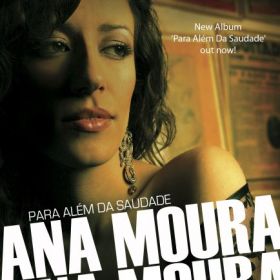
At the end of 2006, Ana Moura started to record her third original album, that was released on the first semester of 2007. In “Para Além da Saudade”, Ana Moura sings the traditional Fado Blac or Fado Azenha, but still risks on some new songs and partnerships, singing poems from Fausto (one of the most important Portuguese singer-songwriters), Amélia Muge and Nuno Miguel Guedes. Once again, Jorge Fernando produced, wrote and composed some of the songs of “Para Além da Saudade”.
This record was presented live, for the first time, at the Olga Cadaval Cultural Centre, in Sintra, for an audience that longed to hear her. After a small tour in Germany and Holland, she is preparing to tour her new album through the country. Meanwhile, Ana Moura still thinks of how and where it all began, and of the importance of keeping those vital ties alive. "Before," she muses, "I used to sing in the fado house every day. Today, because of my concert schedule and travel, it's impossible. But, when time permits, I like to return. Sometimes I feel that I must go there. I need that."